The contracts and grants you can win, matched, teamed and written for you.

Contracts from SAM.gov and grants from Grants.gov on one board, from the notice to a package ready to submit.

Tens of thousands
of federal contracts and grants
700,000+
registered firms to team with
Minutes
to your first match
The home screen: every pursuit in its stage, with the dates taken from the notices.
Contracts and grants

Both worlds. One workspace.

The same board and the same stages, in each world's own words. The firm that bids a painting IDIQ in March and applies for a housing grant in June works in one place.

From a SAM.gov notice to a priced, teamed, reviewed, submitted proposal.

Contract briefThe notice and every attachment read, with the sentence behind each finding.
Contract valueThe published range, or comparable awards escalated to today.
Bid or passThe decision, with its reasons, recorded by a person.
TeamPartners ranked, invited, signed, and locked to scope.
ProposalEach volume written to the evaluation criteria, in your own template.
ReviewRequirements matched to the draft, then scored like an evaluator.
SubmitChecks, attestations, the package counted, the award watched.

From a Grants.gov announcement to an eligible, budgeted, reviewed application.

Grant briefThe announcement and its files read: what is funded, for whom, how much.
Award sizeFloor, ceiling, cost share, and the budget rules worked out.
EligibilityWho may apply, in the announcement's own words.
What to submitThe narrative, the budget and the forms, from the announcement's checklist.
ApplicationSections written to the review criteria and the page limits.
ReviewScored against the review criteria before a reviewer sees it.
SubmitChecks, attestations, the package counted, the award watched.
One pursuit, start to finish

From the notice to a package ready to submit.

A pursuit is one contract or one grant. Eight stages, in the order the work happens. Crafteny does the work; you make the calls.

01

Match

New contracts and grants matched to you every day, each with a short summary of what it asks and what it is worth.

02

Decide

Whether you are eligible, what it is worth, and a clear bid or no-bid call, so the decision takes a minute.

03

Team

The right partners ranked for this pursuit, then invited, documents exchanged and agreements signed.

04

Price

A contract value estimate and guidance on the price that wins, or a full grant budget checked against the federal cost rules.

05

Write

The proposal or application written for you, to the evaluation criteria, in your own template.

06

Review

Checked against every requirement and scored like an evaluator, before you ever see it.

07

Submit

SAM registration verified and the package ready to submit, with a record of what went in and when.

08

Win

Award notices watched for you until you know the outcome.

Screen by screen

The screens you work in.

Match: Published notices matched and searchable, each carrying its fit, what it is worth and its deadline.
Decide: What the government is buying, the requirements that decide it, and why it matched you.
Track: Every pursuit in its stage with its deadline. Quill sits in the top bar and answers from your own documents.
Click to expand
Match

Published notices matched and searchable, each carrying its fit, what it is worth and its deadline.

Value and pricing

What it is worth, and what to bid.

A contract priced from the government's own task list, or a grant budget built in the federal categories. Every figure carries where it came from.

What the work is worth, and the price that stands a chance of winning it.

Anchored, never guessedThe published range where the notice states one. Where it states none, what comparable federal awards actually funded, brought up to today.
Priced in its own unitsThe bid schedule taken whole and priced row by row. A square of paint is a hundred square feet, and each unit is summed on its own.
Every figure shows its sourceStated in a file, drawn from one, or entered by you. Nothing on the screen is a number without a reason.
Your workbook, back againDownload it, price it in Excel, upload it, and the price volume picks it up.

The full federal budget, built as you type and held against what the announcement allows.

The award rules, worked outFloor and ceiling as the announcement states them, whether the ceiling is direct or total cost, the cost share and the period.
The federal categoriesPersonnel, fringe, travel, equipment, supplies, contractual, construction, other, and indirect on the base the announcement allows.
Live arithmeticTotals as you type, cost share computed, and each category measured against the announcement's own limit where it states one.
Checked against the rulesEquipment against the per-unit threshold, subawards against the indirect base, and the unallowable named where it appears.
The contract value stage: a bid schedule priced row by row, with each figure showing its source.
Teaming

700,000+ registered firms, ranked for the pursuit in front of you.

Whole teams to compare, then the invitations, the materials and the agreements, all inside the pursuit.

Whole teams built for this pursuit, each one a complete assignment of the work.

Inside the limitEvery option stays inside the subcontracting limit the set-aside carries.
Ranked against the gapsPartners drawn from the registry and scored on what this pursuit needs and you do not hold.
Compare before you commitTaking one assigns all the work at once and commits nothing until you lock the team.

The work broken into items, each one owned by you or by a named partner.

Critical work firstThe requirements that decide the award are tracked until each one has an owner.
Your share, countedYour share of the work is counted as you assign it, so you see the limit before you commit.
Item by itemTake a whole option, or hand a single requirement to a single firm.

Sent to a named contact at each firm, accepted or declined on a page.

No account to createThe partner opens a link, reads what is being asked, and answers.
Materials by nameCapability statement, certifications, past performance, representations, each asked for by name.
Mark received, or ask againYou mark what has arrived and send anything back for a change. Every version is kept.
A decline is not silenceWork held by a firm that declines comes back, and the stage names what to reassign.

Drafted for each partner from the pursuit itself, then consented to.

Scope, share, termThe work, the share, exclusivity and the term, drawn from the assignment you made.
Consent is versionedThe partner consents to the version they read, and a redraft asks them again.
Your paper if you preferExport as a Word document, or upload the signed copy from a partner's own template.
The team stage: work assigned, teams to compare, invitations out and agreements consented.
Writing and review

Written to the criteria, then scored before anyone else sees it.

Drafted in your own template and assembled to the instructions the notice gives.

Written to the scorecard

Every paragraph answers a question the evaluators will score, and the files are the ones the notice asks for, in its order.

Audited against the requirements

Each requirement matched to the draft and named as answered, missing or critical.

Scored the way the board reads it

A rating for each part of the scorecard, strengths credited only on evidence, and the overall rating set by the lowest.
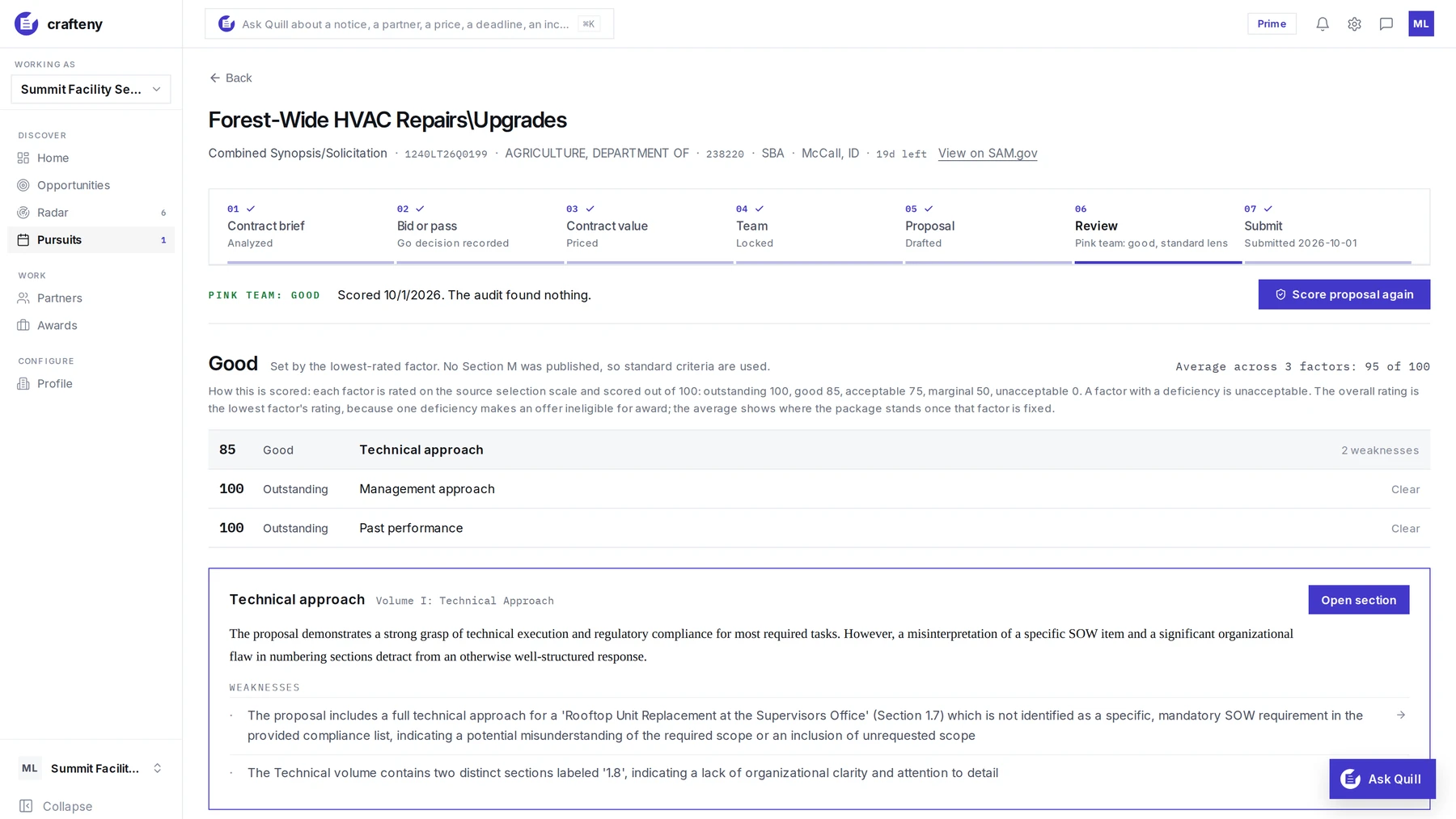
The proposal stage: volumes written to the scorecard and audited against the requirements.
Who it is for

Bid for yourself, lead the team, or run bids for your clients.

One platform, whichever seat you sit in.

Bidding for yourself

Matched to the contracts and grants that fit your work, then priced and written to the criteria.

Leading the team as the prime

The partners you are missing, brought in and signed before the drafting starts.

Running bids for your clients

A workspace per client, each with its own profile, pursuits and documents.

Questions.

Contracts from SAM.gov and grants from Grants.gov, refreshed every day and matched to your profile.

A contractor sets up from one, and it fills the profile from your SAM registration. A grant applicant without one can still begin and add it later.

You do. Crafteny lays out whether you are eligible, what it is worth and how well it fits, and you make the call.

A changed notice comes back to your board, and the analysis is read again from the new documents.

Yes. Drafts are written into your template, from your past performance and your partners' material.

On a page, from a link in the invitation, with no account to create. Consent is recorded against the version they read, and a redraft asks again.

Your next award starts here.

Sign in, set up your profile, and see your first matches in minutes.